I used to ride the bus to work…
I used to ride the bus to work every day. It took some getting used to after commuting in my beloved VW for years, but gas prices being what they were (and are) I got the hang of it. The initial shock was profound, though. People don’t always wash themselves. Sometimes they sneeze and the mist settles on your face. I heard my fair share of sly drug deals that weren’t nearly as sly as the dealer thought. Once I got over all of that, though, I became an observer. A fly on the wall. I vanished in my seat once I sat down, often with a book, but rarely actually reading it. People ignore readers. Readers are distracted by words. Under my cloak of reading-induced invisibility, I found that not all of us require a book to be distracted by words. Some of us, about one in one hundred, are distracted by words all day long. On my bus, the CT1, I happened to be in the right spot to watch such an individual day after day as he handled the words that played in his head and slipped from his tongue. On my bus was a schizophrenic.
I’ve read, and can highly recommend, The Quiet Room by Lori Schiller, which recounts the struggles from onset to partial control of schizophrenia from someone who experienced it firsthand. I’ve watched documentaries and read articles. I know what they did to schizophrenics a few hundred years ago (and as recently as the 1960s), and I see people with clearly visible symptoms wasting the day away on a park bench. On the bus, in my obscurity, I watched the condition at a respectable distance for a significant amount of time. From external reactions, I saw a glimpse of what was going on internally. What did I find there? Words, just like the ones I wasn’t reading. I found words, happening in much the same way in his mind as they were happening in mine.
Now let’s take a look at words for a moment to put this into context. What is thought? Is it a picture of a bicycle? Yes. Is it a computation ingrained along some neural pathway from a long forgotten calculus class? Yes, that too. Most importantly for this conversation, though, it is words. We think in sentences, or fragments, or even individual letters at times, depending on the circumstance. Almost always, a thought that you have is your internal dialogue, a dialogue that has been buried deep inside you since you were very little and you were told “shhhhhhhhhhh” during quiet time, but you still needed that external dialogue to help you get that square block into the circular hole. Once it is buried through the practice of “shhhhhhhhhhh,” we largely forget about it. We all need internal dialogue to navigate our world, whether to type this sentence (I can hear myself if I think about it) or you are rebuilding an engine or replanting a hyacinth. We need that dialogue, and that dialogue is thought.
Schizophrenics generally grow up just as you and I. They build an inner dialogue as they go, amassing thoughts and words without noticing the gears turning in their heads as they unfold the newspaper or put on their pants one leg at a time. And then one day, out of the blue, they are swept away by an unexplainable sense of euphoria and dazzling hope, or plummeted into a hell of agonizing paranoia, and without warning the voices start. The words creep out. Those voices, the ones that keep schizophrenics up for days on end and convince them that the TV is talking to them or that the neighbors (or fellow bus riders) are spying on them, are really just that inner dialogue that we all have. The difference, for reasons that aren’t yet clear, is the part of the brain that tells you “Shhhhhhh, these are internal voices” suddenly gets switched to “Listen up!! Someone is talking to you!” Schizophrenics, it would seem based on contemporary theory, are stuck listening to their thoughts, but can’t tell anymore that it’s just their inner dialogue.
The young man on the bus, we’ll call him Gary because that’s the word my mind attaches to him, was listening to the words rolling around in his head, just as I was as I sat thinking about him. Gary carried on conversations and spoke with his hands, sometimes laughing at or responding to conversations that other people were having – exactly as I would. Often the other passengers would respond to him, and I would wait patiently for the inevitable – slowly they would realize that Gary wasn’t speaking to them. Slowly, invariably, they would recoil and glance at the other passengers to make sure they were not the “crazy” ones. That was the word in their heads – crazy. As I watched Gary over the course of a few months, I quickly began questioning that defense. Was Gary that much different than the rest of us? Other than a thought switch being flipped in the permanent unfiltered position, was Gary any crazier than you or I? The answer, in short, is no. And then, as a writer, I wondered how access to those thoughts, in a much more controlled way, may offer some insight into myself, others, and the human condition as a whole, if only I would hear the words… and perhaps respond to them.
Those voices in your head, the same ones that pester and taunt and trouble a schizophrenic, are at your disposal if only you listen. You have fears that you quash. Don’t quash them. You long for things that society tells you are bad, so you shut it out of your mind. Let it in. You, me, and everybody you have ever known thinks things that you are afraid to look straight in the eye because of what it might mean, perhaps something that you don’t even want to admit to yourself about yourself. Write it.
I felt for Gary as I spied on him from my perch. His life must be confusing, so confusing that some schizophrenics don’t last too long, ending up in an institution or taking their own lives in a desperate attempt to stop those endless, tiring words. From my seat in that bus, I gained a better understanding of what it was to no longer be in control of the characters in your mind that you’ve collected over the years, and for that I will always remember and have limitless sympathy for Gary and everyone like him. But I took away something about myself as well. I learned to really listen to what was going on upstairs. Those voices, those words, are the ones that we should be writing with. They’re already in there and ready-made, so instead of suppressing them, what would happen if we let them fully speak? Where would they take us? What would they say? Some of it, surely, will be uncomfortable, but for all of the discomfort and ugliness there must be an equal amount of poignancy and endearment. There’s a wealth of voices and words, stored and cataloged for as many years as you’ve been alive, waiting to be rewritten as characters and a plot in a book that someone will pretend to be reading on a bus as they sit and spy on the other passengers. And you never know. Perhaps one day I will be holding that book. Perhaps I will be spying on you.
See you on the bus…
—Alex Pucher
Would you like to know more about these ideas? Click on the hyperlinks within the blog.
And of course, check out The Quiet Room by Lori Schiller:http://www.goodreads.com/book/show/125424.The_Quiet_Room
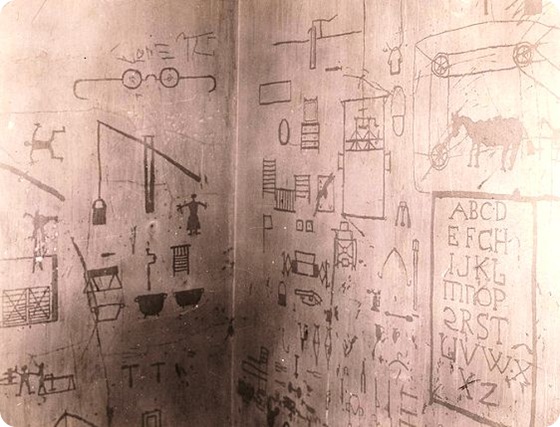
Cover Photo: St. Elizabeth’s Hospital. Wall of room in Ward Retreat 1. Reproductions made by a patient, a disturbed case of dementia precox.
